


Because I write mostly science fiction, building up the worlds in my stories is a huge part of the planning and writing. But even if you write contemporary fiction, your book is set in some kind of world-- a high school, a certain city, a flavorful region of the world.
There are lots of components to building that setting and world, and I've been thinking a lot lately about culture. Culture is basically the shared knowledge, values, and practices of a group of people, and it is a HUGE part of any fictional world (or at least it should be, in my opinion).
 I didn't really understand how different culture could be until I traveled to Ghana for the first time. Before I went, I was all, "Culture shock? Ha. I can handle anything."
Then I got there and freaked out a little.
At first, I thought the culture shock came from having to bathe from a bucket in cold water, and cramming with six people I didn't know in the back seat of a taxi, and being asked why I didn't eat the chicken bones (they suck the marrow out). Then I realized that the biggest problem with culture shock is that I couldn't forgive Ghana and its culture for not being MY culture. I didn't understand the values behind the behavior, so I couldn't accept it. Once I was able to learn from the people around me, and to look at behavior or customs and say, "this is the way it is because of this reason," I was able to love it.
So today I wanted to talk about how you can look outside your own culture to create a new culture for your stories by using that basic principle. (If you're really interested in learning more, this is where I pulled a lot of information from.)
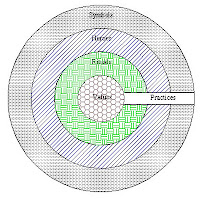 Building a culture in your story is as simple as this diagram. Ha! Okay, if only it were that simple. But once you understand and can identify these different things in your fictional world, voila! You've got the beginnings of your very own new culture. And it centers around, as I mentioned, values.
A value is anything a group of people considers important-- objects, conditions, thoughts, characteristics, etc. What do they identify as "good" and "bad"? Maybe they're a warrior culture and value the ability to be cunning and ruthless, or a culture of dispossessed jesters that value wit and sarcasm. Whatever values work for your story, your culture can value them-- or even NOT value them, if that's the point you want to make.
Rituals, in the next circle, are actions performed that have some kind of symbolic value as dictated by tradition. Maybe your high school crowd has a hazing ceremony for kids coming into a certain club. Maybe there's a certain greeting people exchange, like the hand-shake-while-snapping-fingers-together that I learned in Ghana. It could be birth and funeral customs. In The Hunger Games, the Games themselves are a ritual. Even if you never fully show them in your story, they're an important part of culture to develop.
Heroes-- well, that's easy. It's people (alive or dead) who are role models. They represent those values your culture prizes. They could be Oprah or Michael Jordan or Alastor Moody. Maybe some parts of your culture-- a certain class, maybe-- values one person, while another class holds up someone else as a hero.
Symbols are what we think of most often when we think of culture. It's dancing, or slang words, or objects, dress, food, hairstyles, or even events that define the culture and are significant to them. It's the dish fufu that is the national pride in Ghana that they insist every foreigner has to try, and the light sabers of the Jedi in Star Wars. It can even be national holidays that commemorate events (though this often ties into rituals as well).
These three things-- rituals, heroes, and symbols-- make up the practices of a culture. They are almost always tied to your culture's values. There are a lot of ways these things can show up in a culture: in gender roles, politics, and communication. They can vary in the same culture between social classes or generation gaps.
In other words, it can get really complicated.
Which, honestly, I like. Not every book needs a complicated culture; in some books, it might get in the way. But even if it only comes out through your characters, culture can strengthen a story. How does the main character feel about her world, in contrast to how other characters feel about it? How was your character shaped by the culture? Even if you can develop just enough culture that you can use it to strengthen your characters, you'll strengthen the whole world.
So, my friends, have you developed a strong culture for the world in your book? How do you approach worldbuilding? What books do you think did a particularly fantastic job of developing the world and culture?
There are lots of components to building that setting and world, and I've been thinking a lot lately about culture. Culture is basically the shared knowledge, values, and practices of a group of people, and it is a HUGE part of any fictional world (or at least it should be, in my opinion).
 I didn't really understand how different culture could be until I traveled to Ghana for the first time. Before I went, I was all, "Culture shock? Ha. I can handle anything."
Then I got there and freaked out a little.
At first, I thought the culture shock came from having to bathe from a bucket in cold water, and cramming with six people I didn't know in the back seat of a taxi, and being asked why I didn't eat the chicken bones (they suck the marrow out). Then I realized that the biggest problem with culture shock is that I couldn't forgive Ghana and its culture for not being MY culture. I didn't understand the values behind the behavior, so I couldn't accept it. Once I was able to learn from the people around me, and to look at behavior or customs and say, "this is the way it is because of this reason," I was able to love it.
So today I wanted to talk about how you can look outside your own culture to create a new culture for your stories by using that basic principle. (If you're really interested in learning more, this is where I pulled a lot of information from.)
 Building a culture in your story is as simple as this diagram. Ha! Okay, if only it were that simple. But once you understand and can identify these different things in your fictional world, voila! You've got the beginnings of your very own new culture. And it centers around, as I mentioned, values.
A value is anything a group of people considers important-- objects, conditions, thoughts, characteristics, etc. What do they identify as "good" and "bad"? Maybe they're a warrior culture and value the ability to be cunning and ruthless, or a culture of dispossessed jesters that value wit and sarcasm. Whatever values work for your story, your culture can value them-- or even NOT value them, if that's the point you want to make.
Rituals, in the next circle, are actions performed that have some kind of symbolic value as dictated by tradition. Maybe your high school crowd has a hazing ceremony for kids coming into a certain club. Maybe there's a certain greeting people exchange, like the hand-shake-while-snapping-fingers-together that I learned in Ghana. It could be birth and funeral customs. In The Hunger Games, the Games themselves are a ritual. Even if you never fully show them in your story, they're an important part of culture to develop.
Heroes-- well, that's easy. It's people (alive or dead) who are role models. They represent those values your culture prizes. They could be Oprah or Michael Jordan or Alastor Moody. Maybe some parts of your culture-- a certain class, maybe-- values one person, while another class holds up someone else as a hero.
Symbols are what we think of most often when we think of culture. It's dancing, or slang words, or objects, dress, food, hairstyles, or even events that define the culture and are significant to them. It's the dish fufu that is the national pride in Ghana that they insist every foreigner has to try, and the light sabers of the Jedi in Star Wars. It can even be national holidays that commemorate events (though this often ties into rituals as well).
These three things-- rituals, heroes, and symbols-- make up the practices of a culture. They are almost always tied to your culture's values. There are a lot of ways these things can show up in a culture: in gender roles, politics, and communication. They can vary in the same culture between social classes or generation gaps.
In other words, it can get really complicated.
Which, honestly, I like. Not every book needs a complicated culture; in some books, it might get in the way. But even if it only comes out through your characters, culture can strengthen a story. How does the main character feel about her world, in contrast to how other characters feel about it? How was your character shaped by the culture? Even if you can develop just enough culture that you can use it to strengthen your characters, you'll strengthen the whole world.
So, my friends, have you developed a strong culture for the world in your book? How do you approach worldbuilding? What books do you think did a particularly fantastic job of developing the world and culture?


